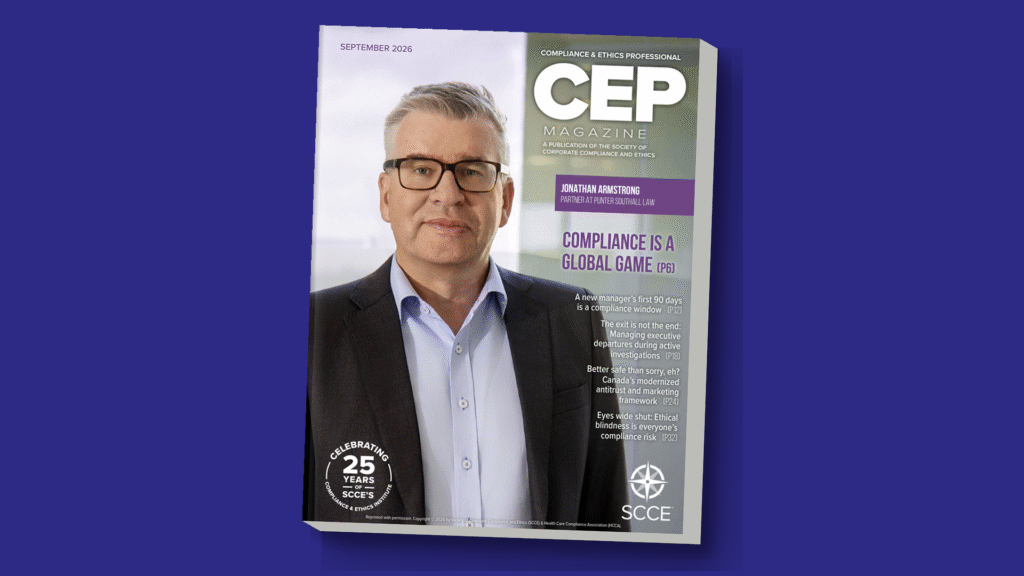
Jonathan is an experienced lawyer based in London with a concentration on compliance & technology. He is also a Professor at Fordham Law School teaching a new post-graduate course on international compliance.
Jonathan’s professional practice includes advising multinational companies on risk and compliance across Europe. Jonathan gives legal and compliance advice to household name corporations on:
- Prevention (e.g. putting in place policies and procedures);
- Training (including state of the art video learning); and
- Cure (such as internal investigations and dealing with regulatory authorities).
Jonathan Armstrong is recognised in The Legal 500 for his work in Data Protection, Privacy and Cybersecurity. The guide notes that “Jonathan Armstrong leads Punter Southall Law’s cybersecurity practice, which is well-positioned to advise on compliance mandates and high-stakes data breaches.”
Jonathan has handled legal matters in more than 60 countries covering a wide range of compliance issues. He made one of the first GDPR data breach reports on behalf of a lawyer who had compromised sensitive personal data and he has been particularly active in advising clients on their response to GDPR. He has conducted a wide range of investigations of various shapes and sizes (some as a result of whistleblowers), worked on data breaches (including major ransomware attacks), a request to appear before a UK Parliamentary enquiry, UK Bribery Act 2010, slavery, ESG & supply chain issues, helped businesses move sales online or enter new markets and managed ethics & compliance code implementation.
Clients include Fortune 250 organisations & household names in manufacturing, technology, healthcare, luxury goods, automotive, construction & financial services. Jonathan is also regarded as an acknowledged expert in AI and he currently serves on the New York State Bar Association’s AI Task Force looking at the impact of AI on law and regulation. Jonathan also sits on the Law Society AI Group.
Jonathan is a co-author of LexisNexis’ definitive work on technology law, “Managing Risk: Technology & Communications”. He is a frequent broadcaster for the BBC and appeared on BBC News 24 as the studio guest on the Walport Review. He is also a regular contributor to the Everything Compliance & Life with GDPR podcasts. In addition to being a lawyer, Jonathan is a Fellow of The Chartered Institute of Marketing. He has spoken at conferences in the US, Japan, Canada, China, Brazil, Singapore, Vietnam, Mexico, the Middle East & across Europe.
Jonathan qualified as a lawyer in the UK in 1991 and has focused on technology and risk and governance matters for more than 25 years. He is regarded as a leading expert in compliance matters.
Jonathan has been selected as one of the Thomson Reuters stand-out lawyer – an honour bestowed on him every year since the survey began. In April 2017 Thomson Reuters listed Jonathan as the 6th most influential figure in risk, compliance and fintech in the UK.
In 2016 Jonathan was ranked as the 14th most influential figure in data security worldwide by Onalytica. In 2019 Jonathan was the recipient of a Security Serious Unsung Heroes Award for his work in Information Security. Jonathan is listed as a Super Lawyer and has been listed in Legal Experts from 2002 to date.
Jonathan is the former trustee of a children’s music charity and the longstanding Co-Chair of the New York State Bar Association’s Rapid Response Taskforce which has led the response to world events in a number of countries including Afghanistan, France, Pakistan, Poland & Ukraine.
Some of Jonathan’s recent projects (including projects he worked on prior to joining Punter Southall) are:
- Helping a global healthcare organisation with its data strategy. The work included data breach similuations and assessments for its global response team.
- Helping a leading tech hardware, software and services business on its data protection strategy.
- Leading an AI risk awareness session with one of the world’s largest tech businesses.
- Looking at AI and connected vehicle related risk with a major vehicle manufacturer.
- Helping a leading global fashion brand with compliance issues for their European operations.
- Helping a global energy company on their compliance issues in Europe including dealing with a number of data security issues.
- Working with one of the world’s largest chemical companies on their data protection program. The work involved managing a global program of audit, risk reduction and training to improve global-privacy, data-protection and data-security compliance.
- Advising a French multinational on the launch of a new technology offering in 37 countries and coordinating the local advice in each.
- Advising a well-known retailer on product safety and reputation issues.
- Advising an international energy company in implementing whistleblower helplines across Europe.
- Advising a number of Fortune 100 corporations on strategies and programs to comply with the UK Bribery Act 2010.
- Advising of Financial Services Business on their cyber security strategy. This included preparing a data breach plan and assistance in connection with a data breach response simulation.
- Advising a U.S.-based engineering company on its entry into the United Kingdom, including compliance issues across the enterprise. Areas covered in our representation include structure, health and safety, employment, immigration and contract templates.
- Assisting an industry body on submissions to the European Commission (the executive function of the EU) and UK government on next-generation technology laws. Jonathan’s submissions included detailed analysis of existing law and proposals on data privacy, cookies, behavioural advertising, information security, cloud computing, e-commerce, distance selling and social media.
- Helping a leading pharmaceutical company formulate its social media strategy.
- Served as counsel to a UK listed retailer and fashion group, in its acquisition of one of the world’s leading lingerie retailers.
- Advising a leading U.S. retailer on its proposed entry into Europe, including advice on likely issues in eight countries.
- Working with a leading UK retailer on its proposed expansion into the United States, including advice on online selling, advertising strategy and marketing.
- Dealing with data export issues with respect to ediscovery in ongoing court and arbitration proceedings.
- Advising a dual-listed entity on an FCPA investigation in Europe.
- Acting for a U.S.-listed pharmaceutical company in connection with a fraud investigation of its Europe subsidiaries.
- Acting for a well-known sporting-goods manufacturer on setting up its mobile commerce offerings in Europe.
- Comprehensive data protection/privacy projects for a number of significant U.S. corporations, including advice on Safe Harbor Privacy Shield and DPF.
- Risk analysis for an innovative software application.
- Assisting a major U.S. corporation on its response to one of the first reported data breaches.
- Work on the launch of an innovative new online game for an established board game manufacturer in more than 15 countries.
- Advice on the setting up of Peoplesoft and other online HR programs in Europe, including data protection and Works Council issues.
- Advising a leading fashion retailer in its blogging strategy.
- Advising one of the world’s largest media companies on its data-retention strategy.
- Advising a multinational software company on the marketing, development and positioning of its products in Europe.